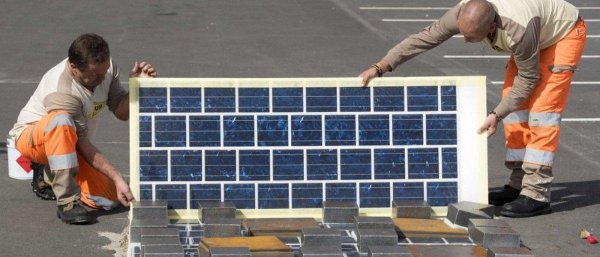
TOUROUVRE-AU-PERCHE, France — A small municipality in Normandy, created just this January, is now home to what French officials are calling the world's first solar road. On Wednesday, Ecology Minister Ségolène Royal inaugurated a one-kilometer stretch of pavement embedded with photovoltaic panels, a project that cost approximately $5.2 million and took five years to develop.
The 2,800 square meters of solar cells, manufactured by the French company Colas, are coated with a clear silicon resin designed to withstand the weight of traffic. Before installation, the panels were tested in four car parks across the country. The town of 3,400 residents will now rely on this innovative surface to power its street lights.
France is exploring the possibility of expanding the technology to an additional 1,000 kilometers of national roadways. However, Colas has acknowledged that reducing production costs is a prerequisite for any large-scale rollout. The country's total road network spans about one million kilometers, a fact that Royal highlighted when she argued the project "takes advantage of large swathes of road infrastructure already in use…to produce electricity without taking up new real estate."
Critics Question Efficiency and Price
Not everyone is convinced. Marc Jedliczka, vice president of the renewable energy network CLER, told Le Monde that while the technology represents "a technical advance," it may be an expensive distraction. "There are other priorities [that are greater than] a gadget of which we are more certain of the fact that it is very expensive than the fact that it works," he said.
A key technical concern is that the panels are laid flat, unlike conventional solar arrays that are angled to maximize sun exposure. This orientation is expected to reduce electricity generation efficiency. Jean-Louis Bal, president of the renewable energy union SER, echoed the need for more data, stating, "We have to look at the cost, the production [of electricity] and its lifespan. For now, I don't have the answers."
Despite the skepticism, the project represents a deliberate experiment in renewable energy. Supporters argue that trial and error is a necessary part of scientific progress, and the road will serve as a real-world test of durability, energy output, and long-term maintenance.
The initiative comes amid broader global conversations about climate change and the need to diversify clean energy sources. Whether solar roads become a practical solution or remain a costly demonstration, the data gathered here will inform future decisions.






Comments
0