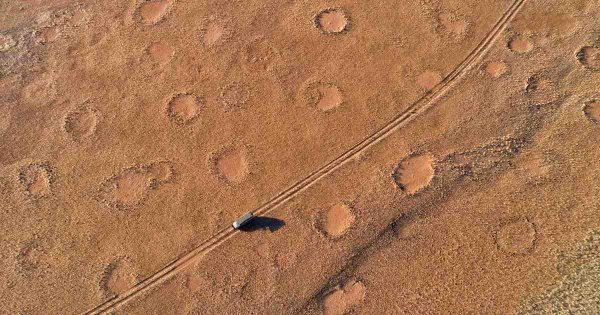
An international team of researchers has used artificial intelligence to detect thousands of circular vegetation patterns, known as fairy circles, in drylands across 15 countries, a finding that dramatically expands the known range of these mysterious formations. The study, published in the journal Proceedings of the National Academy of Sciences, identified the patterns in 263 locations spanning Africa, Madagascar, Western Asia, and Southwest Australia, according to the research team.
The researchers trained a neural network on more than 15,000 satellite images from Namibia and Australia, where fairy circles have been documented for decades. Roughly half of those training images contained the circular patterns. The AI system then analyzed satellite views of over half a million 2.5-acre plots of land in other regions, flagging locations that matched the visual signature of fairy circles.
The newly identified sites are predominantly hot, sandy areas that receive between four and 12 inches of rainfall annually, a climate profile consistent with the known habitats of these patterns. However, the study's authors caution that the AI-detected formations may not all share the same underlying cause.
Debate Over Origins Persists
The formation of fairy circles remains a contentious topic among ecologists. Some researchers attribute the bare patches to termite activity beneath the soil, while others propose that self-organizing plant dynamics create the patterns. The new study does not resolve this debate, and some experts have questioned whether the AI-identified sites even fit the loose definition of fairy circles.
Norbert Jürgens, an emeritus ecologist at the University of Hamburg who was not involved in the research, told the New York Times that various types of bare patches exist in arid regions, caused by different processes. Michael Cramer, an ecophysiologist at the University of Cape Town, also not involved, noted that the term “fairy circle” lacks formal guardianship, implying that its application to new sites may be subjective.
Co-author Fernando Maestre, an ecologist at the University of Alicante in Spain, acknowledged to the NYT that the topic is “hotly debated,” but added, “We are not trying to fight with anyone.”
AI Findings Raise New Questions
The study's use of AI allowed researchers to scan vast areas of land that would have been impractical to survey manually. Emilio Guirado, a co-author from the University of Alicante, told Newsweek that the importance of termites appears greater in Namibia than in Australia or the Sahel zone, suggesting that multiple mechanisms may be at play depending on the location.
Guirado added that “more specialized fieldwork is required to provide more information and results on the formation of these intriguing vegetation patterns.” The study, while expanding the known distribution of fairy circles, underscores how much remains unknown about these natural phenomena.
The findings add a new layer to the ongoing scientific inquiry, with researchers acknowledging that all proposed hypotheses—termites, plant self-organization, or a combination—may hold validity in different contexts. As Guirado put it, “It is likely that all of them are valid where they have been described and that some could be combined in a few places at once.”






Comments
0