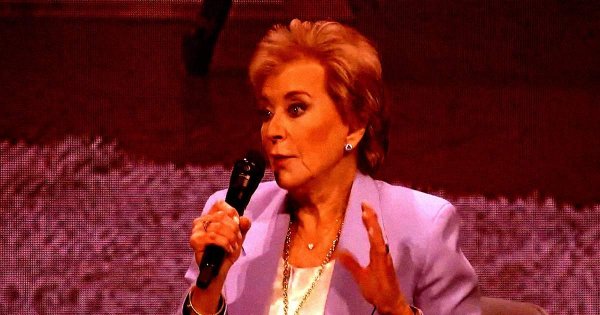
During a recent education summit hosted by Silicon Valley venture capitalists, U.S. Secretary of Education Linda McMahon repeatedly referred to artificial intelligence as "A1," the name of a popular steak sauce. The mispronunciation, captured on video, has sparked questions about the administration's familiarity with a technology that is rapidly reshaping classrooms.
McMahon, a 76-year-old former professional wrestling executive appointed by President Donald Trump, used the term while discussing potential uses of AI in early education. "I wish I could remember the source, but there's a school system that's going to start making sure that first graders or even pre-Ks have A1 teaching every year starting that far down in the grades," she told the audience. She added, "Kids are sponges, they just absorb everything, and so it wasn't all that long ago that we're going to have internet in our schools. Now, okay, let's see A1, and how can that be helpful in one-on-one instruction."
The reference to internet adoption in schools is notable, as public schools in the U.S. began integrating the internet in the mid-to-late 1990s—more than two decades ago. Some observers have speculated that McMahon might have been referring to the America First Policy Institute, a group she once chaired, which is sometimes called the "1A Policy Institute." However, she did not mention that organization during the panel, and the context of her remarks strongly suggests she was discussing artificial intelligence. Notably, she pronounced "AI" correctly earlier in the same appearance, adding to the confusion.
McMahon's background includes founding the company that became World Wrestling Entertainment, Inc. with her husband Vince McMahon in the 1980s. She also served as administrator of the Small Business Administration during the first Trump administration. She has no formal experience in education, a fact that has drawn criticism from those who question her qualifications for the role.
Why AI in Schools Is a Contentious Issue
The mispronunciation comes at a time when the use of AI in education is highly debated. Students worldwide have adopted generative AI tools like OpenAI's ChatGPT, despite concerns about "hallucinations"—instances where AI produces plausible but incorrect information. Critics worry that young students may take such outputs at face value, while proponents argue that AI can help overworked teachers by automating routine tasks.
A recent study by the educational resource organization Twinkl found that 62 percent of U.S. educators regularly use AI in their work. However, 69 percent of teachers reported receiving no formal AI training from their schools, suggesting a significant gap in preparedness.
Efforts to introduce AI to younger children have also emerged, with companies creating tools that allow elementary and pre-K students to generate short stories or interactive presentations. But experts caution against early reliance on such technology.
Ying Xu, an assistant professor at the Harvard Graduate School of Education, addressed these concerns in a podcast last year. "The big question becomes whether children can benefit from those AI interactions in a way that is similar to how they benefit from interacting with other people," she said. Xu acknowledged the potential for personalized learning but also voiced worries about children becoming "more attached to AI than to the people around them."
McMahon's apparent lack of familiarity with the acronym "AI" raises broader questions about the federal government's ability to guide AI policy in education. The situation is further complicated by Trump's announcement last month of plans to dismantle the U.S. Education Department, which would leave such decisions to individual states.






Comments
0